
Photo: Collected
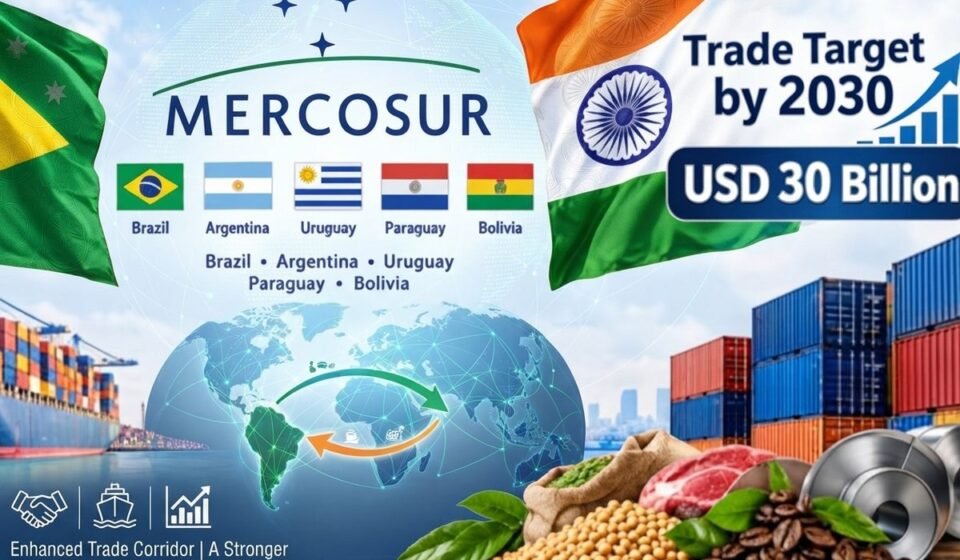
Trade relations between Brazil and India are set to get a new dimension. A huge target has been set to take the volume of trade between the two countries to $30 billion by 2030. To meet this target, the two countries have started work to further widen the scope of the ‘Mercosur’ trade agreement.
Brazil’s Minister of Development, Industry and Trade Marcio Elias Rosa met India’s Commerce and Industry Minister Piyush Goyal on the sidelines of the G20 trade ministers’ meeting. After the meeting, he told news agency IANS that India’s economy is extremely important for the whole world and Brazil has quite good relations with it. As the current trade agreement is limited, they are now moving towards a broader agreement.
‘Mercosur’ is the South American trade bloc comprising Brazil, Argentina, Uruguay, Paraguay and Bolivia. A preferential trade agreement (PTA) has been in effect between India and Mercosur since June 2009, under which tariff concessions of 10 to 100 per cent are given on 450 products of India and 452 products of Mercosur.
According to the Brazilian minister, this number is very negligible. So the two countries are now planning to turn it into a full-fledged free trade agreement (FTA), which will open up a big market for both countries in goods, services and investment.
Talks on expanding the agreement began on 14 September, and on 1 October the two countries completed the work of finalising the outline or ‘terms of reference’ of the agreement. Rosa said this is much like the outline being prepared with the United States; as it has been finalised, the work of preparing new proposals will now proceed. Besides, to avoid customs hassles, the two countries also signed a protocol on accepting electronic certificates on 14 September, as a result of which paperless trade will become easier.
This new trade target was fixed during Brazilian President Luiz Inacio Lula da Silva’s visit to India in February this year. The move is mainly to find new export markets amid the volatility of the world economy.
Trade Minister Rosa described his meeting with India as ‘excellent’ and said more work will be done on this matter in the coming months. In future the two countries will not remain stuck on tariff concessions alone; they will also work together on important areas such as the bioeconomy, circular economy, digital economy, artificial intelligence (AI), skills development and the defence sector.