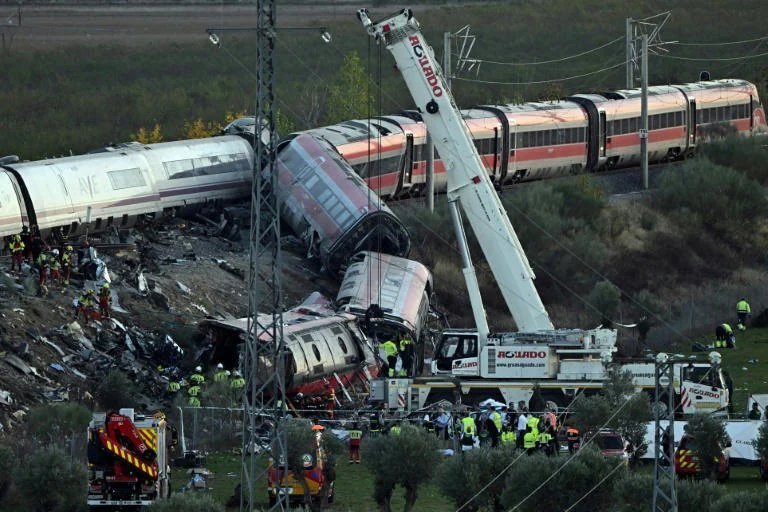

Photo: Collected
Three days of national mourning began in Spain on Thursday. For the second time this year, a collision between two high-speed trains has claimed 68 lives in the country, while a large number of people have been injured.
Family members of the missing are waiting desperately for news of their loved ones.
It is one of the worst rail disasters in Europe this century. After the transport minister cited a ‘fault’ and ‘unexplained circumstances’ as the cause of the crash, fresh questions have been raised about the safety of the country’s rail network.
News agency AFP reported this from Urda, Spain.
The collision took place on Wednesday morning in the Castilla-La Mancha region of central Spain. A train run by state rail operator Renfe hit the rear of another train that was standing still. The stationary train belonged to the private Spanish company Iryo.
AFP journalists said emergency workers carried out rescue operations through the night at the crash site on the key line linking Madrid with the southern city of Seville. Parts of the mangled metal structures were moved with cranes to search for more casualties in the wreckage.
Josimar Medina, a 31-year-old Peruvian national, had come to Spain on holiday with his girlfriend. He said he had been asleep on the Renfe train. In his words, ‘I woke up to find myself floating in the air.’
Pablo Mejía, 42, survived despite suffering a head injury. He told AFP that changing seats at the last moment saved his life.
Wearing a blood-stained grey sweater and holding a battered suitcase, Mejía described the horror of the crash. He said, ‘There was a very hard jolt. Many people were lying on the floor on top of one another. The seats had been ripped out and suitcases were scattered everywhere. Everything was utter chaos.’ He added, ‘I feel as if I have been born again.’
Family members who came looking for missing relatives have been accommodated at a school near Urda, about 130 kilometres south of Madrid. Red Cross workers helped those who arrived there; some broke down in tears. Police and journalists from various countries also crowded the place.
According to Red Cross psychologist Carmen García, a ‘long and difficult time’ lies ahead, as each person will cope with the situation in their own way. She said, ‘We have people who are still in a state of trauma and have not been able to grasp what happened. Some are angry, some are sad, and some are anxious. It will be hard for them to get over their grief.’
The Civil Guard has opened four offices in Madrid, Toledo, Córdoba and Seville to collect DNA samples from relatives of the dead and to identify the missing. Blood donation centres have also been set up in Castilla-La Mancha and Madrid.
José Miguel Fernández, the parish priest of Urda, has stood by the victims’ families alongside emergency workers. In his words, ‘The most important thing is to be with the relatives of the dead and the missing, to make them feel that we are close to them.’ The priest said words are of no value at such a time, but a hug can offer comfort.
Recalling how he rushed to the crash site, Fernández said that there he saw ‘a terrible scene of destruction, despair, uncertainty and death’.
Transport Minister Óscar Puente said on Wednesday that the automatic control system had failed on a 69-kilometre section of the line, so all train services on that section were halted. According to him, the Renfe train travelled 25 kilometres before hitting the Iryo train. Puente said, ‘The control centre had enough time to detect the fault. But they did not fix it.’
Earlier, in January, 46 people died in a collision between two high-speed trains in southern Andalusia. On that occasion, one train derailed onto the adjacent track and collided with the other train. The investigation into that crash is still under way. However, the country’s left-wing government faced sharp criticism over alleged failures in rail management.
This crash comes at a time when Socialist Prime Minister Pedro Sánchez is trying to overturn unfavourable opinion polls and hold on to the premiership he has held for eight years in the snap general election on 29 November.
Background
According to a report by Catalan outlet Ara on 23 January 2026, Spain’s Railway Accident Investigation Commission (CIAF) said in a preliminary report published that day that the main probable cause of the Adamuz crash was that the left-hand rail of the track was already broken before the Iryo train arrived.
According to a Railway Gazette report in February 2026, data from the trains’ recorders still could not be extracted at that point as court permission had not been obtained; Transport Minister Óscar Puente said on 16 February that the Madrid–Seville line was ready to reopen after repairs.
By the numbers
According to a TimesLIVE list of 19 January 2026, Spain’s worst rail disasters include the 2013 derailment of a high-speed train in Santiago de Compostela that killed 80 people, and a head-on collision at El Cuervo in 1972 that killed 86.
At a glance
According to Railway Gazette, the CIAF is Spain’s national rail accident investigation body, which carries out technical investigations separately from judicial inquiries.
Sources
Background sources: Ara, 23 January 2026; Railway Gazette, February 2026; TimesLIVE, 19 January 2026