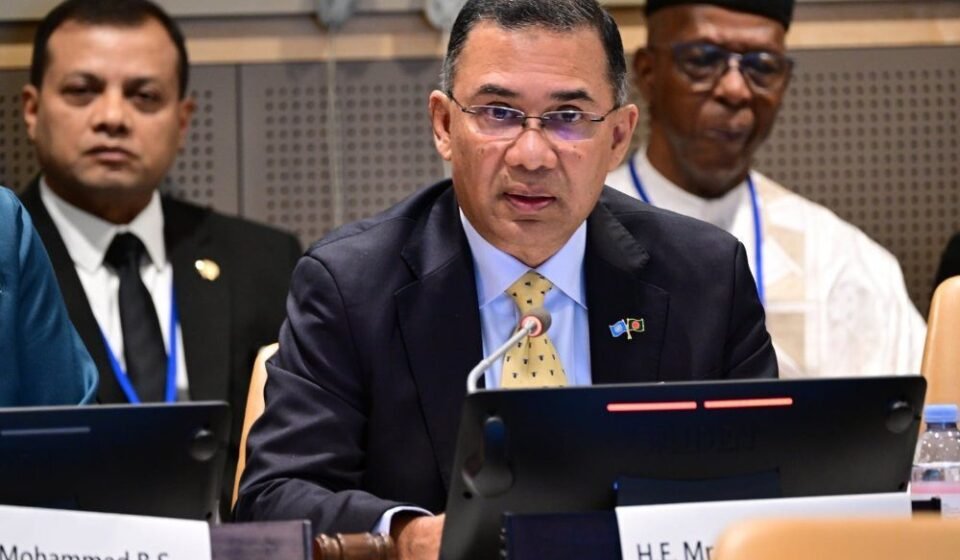

Photo: Collected
Prime Minister Tarique Rahman has placed a five-point proposal for a sustainable solution to the Rohingya crisis.
He also called for preparing a clear roadmap for the speedy, safe, voluntary, dignified and sustainable repatriation of the Rohingyas, ending violence, ensuring adequate and predictable humanitarian assistance, establishing justice and accountability, and strengthening regional and international cooperation to curb cross-border crimes.
The prime minister made these proposals while speaking as the chief guest at a high-level meeting on the Rohingya crisis held on the sidelines of the UN General Assembly session at 11:00am local time today, Tuesday.
Thanking the co-hosts and other partners at the meeting, jointly organised by Bangladesh and The Gambia, the prime minister said the Rohingyas in Myanmar have been victims of extreme discrimination, persecution and deprivation for decades.
The five proposals the prime minister made to resolve the Rohingya crisis are:
First proposal: International and regional stakeholders must prepare a clear and credible roadmap for the speedy, safe, voluntary, dignified and sustainable repatriation of the Rohingyas. The international community must support efforts to restore stability in Myanmar and use its influence to create an environment conducive to repatriation.
Second proposal: All forms of violence against civilians in Myanmar, including the Rohingyas, must stop immediately. Alongside this, the fundamental rights and security of the Rohingyas in their own land must be ensured, so that their confidence about returning safely is restored.
Third proposal: Along with ensuring adequate and predictable humanitarian assistance for the Rohingyas, international support must also continue for the local host communities. The international community must take into consideration that the development aspirations of the local people of Cox’s Bazar are not hindered because of their generous hospitality towards the Rohingyas.
Fourth proposal: Establishing justice and accountability is essential for sustainable repatriation. In this context, the prime minister expressed gratitude to The Gambia for leading the effort to ensure accountability at the International Court of Justice (ICJ). Referring to the important role of the International Criminal Court (ICC) and other international justice and investigative mechanisms, he said those responsible for serious crimes must be made to face strict accountability.
Fifth proposal: Regional and international cooperation must be further strengthened to tackle the drug-based economy, human trafficking, digital fraud, the illegal arms trade and other cross-border crimes that are fuelling instability in this region.
The prime minister said a huge number of Rohingyas have taken shelter in Bangladesh at different times since 1978. Rohingyas also came in several phases in the 1980s. During the tenures of the various governments of the time, arrangements were also made to send some Rohingyas back. However, the situation took a more dreadful turn when fresh violence began in Myanmar in 2017.
He said Bangladesh has been discharging its humanitarian responsibility by sheltering a huge number of Rohingyas for more than nine years. There are currently more than 12 lakh Rohingyas in the country. On top of that, people are still fleeing from Myanmar because of the ongoing violence there.
He further said thousands of children are being born in the camps every year; as a result, yet another new generation is being added to the protracted displacement. Rohingya mothers are dreaming of a safe future for their children, the youth are growing up in extreme uncertainty, and the elderly are nurturing an ardent longing to return to their own land, carrying in their hearts the memories of the homes and villages they left behind.
Stating that Bangladesh opened its border and sheltered the Rohingyas out of a humanitarian urge, the prime minister said their food and healthcare are being ensured in the camps. Rohingya children are being taught according to the Myanmar curriculum at around 6,000 learning centres. Alongside this, the youth are being prepared through skills development training for reintegration in Myanmar’s Rakhine State in the future.
He said although Bangladesh is doing its utmost to improve the standard of living in the camps, these are not an ideal place for living in the long term.
Noting that social, economic, environmental and security-related pressure on Bangladesh is steadily growing because of the protracted displacement, the prime minister said it is not only the Rohingyas who are paying the price of this crisis; it is also having a severe impact on the local host community of Cox’s Bazar.
He mentioned that prolonged uncertainty and frustration are creating newer challenges and security risks. These include various transnational crimes including human trafficking, migrant smuggling and drug trafficking. Many are setting out for Malaysia by boat at the risk of their lives. In his view, this crisis, left unresolved in one country, could turn into a security challenge for the entire region.
Expressing concern over the shortfall in humanitarian assistance, the prime minister said the more the needs grow, the thinner the lifeline of humanitarian assistance becomes. Although more than $934 million in assistance was sought in the 2025 Joint Response Plan (JRP), it has been cut down to around $710 million for 2026, with which only the minimum life-saving needs can be met.
Remarking that ‘this trend cannot be allowed to continue’, he expressed deep gratitude to the international partners standing by Bangladesh and said more international assistance is needed now than at any time before.
The prime minister said the generosity of humanitarian assistance cannot be an excuse for political inaction. Nor can it be expected that Bangladesh alone will carry the burden of the Rohingyas indefinitely.
He said the Rohingya crisis was born in Myanmar, so its sustainable solution also lies in Myanmar.
Expressing concern over the current situation in Rakhine State, the prime minister said the Rohingyas are still being subjected to various forms of persecution including arbitrary detention, restrictions on movement, forced labour and insecurity.
Noting that there are serious allegations of human rights violations against both the Myanmar military and the ‘Arakan Army’, he said that for this reason an environment for safe and dignified repatriation has not yet been created there.
The prime minister made a call, saying now is not the time merely to show empathy; the time has come to identify the root causes of the crisis and move towards a solution. There must be a move from pledges to effective action, and from managing displacement towards ending displacement.
He said Bangladesh does not want the Rohingyas to remain displaced forever. Bangladesh is working towards the goal that they can return to their own homes in Myanmar safely, voluntarily, with dignity and with their rights protected.
Prime Minister Tarique Rahman said, ‘Bangladesh does not want the Rohingyas to remain displaced forever. We want them to return to their own homes in Myanmar safely, voluntarily, with dignity and with their rights protected. Bangladesh has discharged its responsibility with humanity. Now the international community must also discharge its responsibility with firm resolve. Bangladesh will remain ready to assist in their repatriation once the necessary conditions are created.’ He further said, ‘Let us together ensure that the fate of the Rohingyas does not remain yet another story of persecution, expulsion and displacement; rather, let it become a story of justice, dignity and hope. And most importantly, let this story begin right now.’
The event was addressed by Dr Khalilur Rahman, president of the 81st session of the UN General Assembly and foreign minister of Bangladesh, Muhammad B S Jallow, vice-president of The Gambia, and Julie Bishop, the UN secretary-general’s special envoy on Myanmar.
In addition, keynote remarks were delivered by UN High Commissioner for Refugees Barham Salih; European Union Commissioner for Equality, Preparedness and Crisis Management Hadja Lahbib; Abdullah Abdulaziz Al Rabeeah, adviser at the Royal Court of Saudi Arabia and supervisor general of the King Salman Humanitarian Aid and Relief Centre; UK Minister for the Americas, Multilateral and Human Rights Chris Elmore; Turkish Deputy Foreign Minister A Berris Ekinci; OIC Secretary General Ismail Ould Cheikh Ahmed; US State Department Under Secretary of State for Political Affairs Allison Hooker; Permanent Secretary of Thailand’s Ministry of Foreign Affairs Eksiri Pintaruchi; First Assistant Secretary of Australia’s Pacific Strategy Division Craig Chittick; and Malaysian High Commissioner to Bangladesh Md Shuhada Othman.
Among the ministers or high-level representatives of the co-hosts and other member states, those who spoke were World Food Programme Acting Executive Director Carl Skau, UNFPA Assistant Secretary-General Dr Katharina Boehme, OHCHR Assistant Secretary-General Claudia Fuentes Julio and IOM Deputy Director General Justice Ugochi Daniels.
The event was moderated by Irene Khan, Bangladesh’s permanent representative to the United Nations.