
Photo: Collected
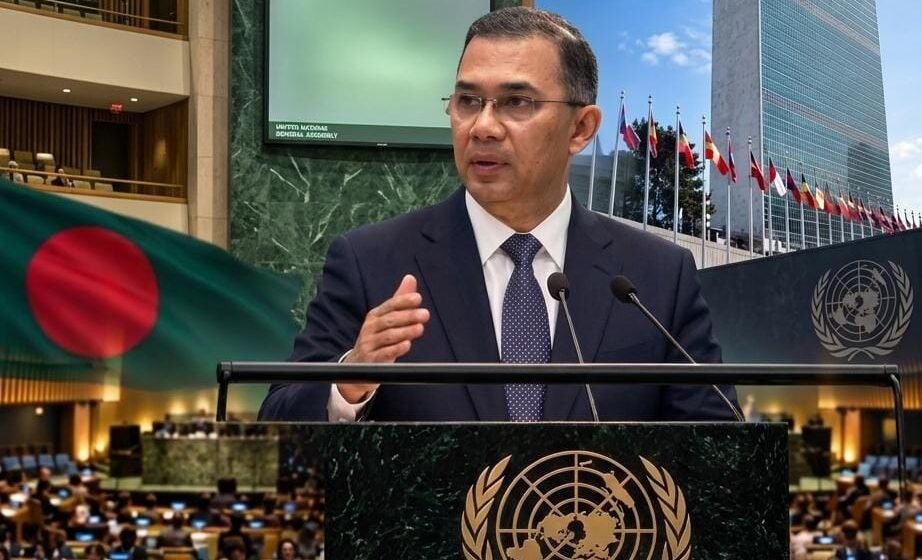
On the stage of the United Nations headquarters in New York, three separate periods of Bangladesh’s history seem set to be strung together this time. More than four decades ago, it was from this very stage that martyred President Ziaur Rahman raised the questions of the inequality of the world order, poverty and the rights of people deprived of development. Later, former Prime Minister Begum Khaleda Zia represented the country in the same international arena. In that continuity, Prime Minister Tarique Rahman will this time speak on behalf of Bangladesh at the UN General Assembly for the first time. This speech of 24 September 2026 is going to be regarded as an important chapter in the formal presence of the third generation of the Zia family in the international arena.
Its historical significance cannot be fully understood if the event is seen merely as a state visit or a routine diplomatic programme. For linked to it are Bangladesh’s thinking on the state, long-standing questions about global justice and the continuity of a political family’s presence on the international stage over three generations.
The first chapter of this story begins in 1980.
On 26 August that year, martyred President Ziaur Rahman addressed the 11th special session of the United Nations in New York. The world economy was then in deep crisis. The rise in oil prices, the debt burden and economic weakness of developing countries, and the inequality between the developed and developing worlds were the central subjects of international discussion. Against such a backdrop, Ziaur Rahman posed the question: despite so many promises of development and cooperation, why must hundreds of millions of people in the world spend their days in poverty and hunger?
This question of his was not born only of Bangladesh’s internal reality. Behind it lay a major debate surrounding the international development thinking of the time. On one side was modernisation theory. Ideas such as W W Rostow’s ‘Stages of Economic Growth’ theory held that if developing countries followed the economic structure of the developed world and received the necessary capital, technology and foreign assistance, they would step by step be able to reach the economic ‘take-off’ stage.
On the other side, dependency theory drew attention to the unequal relationship between the centre and the periphery within the global economic structure. According to this view, the structural inequality of the international trade and economic system makes it difficult for developing countries to change their position. The international reflection of this very debate came in the New International Economic Order, or NIEO, declared by the United Nations in 1974. Later, North-South economic relations were also widely discussed in the international arena. At the 11th special session of the United Nations in 1980 too, the question of international economic cooperation and a new economic structure received importance.
Bangladesh was then a young state, war-ravaged, poverty-stricken and in a food crisis. The shock of the 1974 famine had not yet passed. For this country of around 9.5 crore people, food production, employment and economic reconstruction were major challenges. In this situation, the question of a fair share for developing countries came up in Ziaur Rahman’s speech. He demanded a fairer system in international trade, development assistance, debt, energy and market access. He also put forward the idea that, alongside the developed countries, the oil-rich countries too have a responsibility to protect poor countries from the pressure of the global economic crisis.
A notable aspect of his speech was the concept of self-reliance. In his view, self-reliance does not mean being cut off from the world; rather, it means participating in the international system on equal standing by increasing one’s own production and capacity. That is, on the one hand he raised the demand for global cooperation and fair trade, and on the other he stressed increasing the country’s agriculture, food production and own capacity. It was the combination of these two that gave his international speech a distinctive dimension.
About 13 years after that speech by Ziaur Rahman, his wife Begum Khaleda Zia represented Bangladesh on the stage of the UN General Assembly. With her speech at the 48th General Assembly session on 1 October 1993 began the international diplomatic chapter of the second generation of the Zia family.
After that, she spoke at the commemorative session of the 50th founding anniversary of the United Nations in 1995, the special session on children in 2002 and various events of the 60th General Assembly session in 2005. As a result, her presence on several important stages of the United Nations from 1993 to 2005 built a continuity of presenting Bangladesh’s state position and priorities in the international arena.
This time the third generation is joining that line.
Prime Minister Tarique Rahman left Dhaka for New York on 21 September. On 24 September he will address the 81st session of the UN General Assembly as Bangladesh’s representative for the first time. According to the official version, his speech will include issues such as Bangladesh’s new democratic journey, the rule of law, accountability, world peace and security, climate change, sustainable development, economic cooperation, women and youth empowerment, education and health, the Rohingya crisis, the equitable use of modern technology and reform of the multilateral system.
A look at these issues makes clear how much difference there is between the reality of the Bangladesh of 1980 and that of the Bangladesh of 2026. In Ziaur Rahman’s time, the main questions in the discussion of international justice were food, oil, trade, development assistance and economic inequality. Four decades on, new realities such as climate change, carbon emissions, technology, artificial intelligence, the digital divide, climate finance and sea level rise have been added to that list.
Among these, climate is a particularly important international issue for Bangladesh.
On 23 September, the prime minister will take part in a high-level meeting titled ‘Climate Action and the Just Transition’ organised at the initiative of the UN secretary-general. The following day, he is scheduled to deliver the opening remarks at the UN high-level meeting on the existential risks arising from sea level rise.
For Bangladesh, the matter is not merely a question of environmental policy. It is directly connected with the settlements, agriculture, water security, livelihoods and migration of coastal communities.
Bangladesh’s share in the world’s total greenhouse gas emissions is comparatively very low. Yet the risk of the impacts of climate change is much higher for the country. The combined effect of cyclones, tidal surges, salinity, river erosion and sea level rise could damage Bangladesh’s development in the long term.
According to the World Bank’s estimate, cyclones alone cause economic losses of about one billion dollars a year on average in Bangladesh. Hence the questions of climate finance, adaptation, technology transfer and the fair sharing of responsibility for loss and damage are becoming more important by the day in Bangladesh’s diplomacy.
It is here that the development-justice question of 1980 returns in a new guise. The question then was to ensure fair trade and development assistance for poor countries. And the question now is: who will bear the cost of adaptation for the countries whose contribution to climate change is comparatively small, and how will the necessary technology and finance be ensured?
The same kind of question is coming up in the field of technology as well.
Artificial intelligence, digital infrastructure and new technology are rapidly changing the character of the world economy. However, the benefits of technology are not equally open to all. If inequality is created in advanced technology, skills, infrastructure and finance, a new kind of centre-periphery relationship could be created in the global economy of the future too. For this reason, the issue of equitable access to technology and capacity building is becoming an important international demand for Bangladesh.
Another major issue of Tarique Rahman’s UN visit is the Rohingya crisis.
A huge number of Rohingyas took shelter in Bangladesh after the violence in Myanmar in 2017. A large part of this population has been on Bangladesh’s territory for about nine years. As a result, the crisis is now no longer only a matter of humanitarian assistance; the questions of Bangladesh’s economy, environment, border security and regional stability have also become entangled with it.
The United Nations and partner agencies have appealed for $710.5 million to meet the needs of the Rohingya refugees and the local communities hosting them in 2026. But in this protracted crisis, sustaining international funding is becoming increasingly difficult.
Bangladesh’s position on this matter has long been clear: the source of the Rohingya crisis is in Myanmar, so its sustainable solution too must be found in Myanmar. Repatriation must be safe, voluntary, dignified and sustainable. An opportunity has been created to present this position forcefully once again on the UN stage.
Another special aspect of this year’s session is lending added importance to Bangladesh’s diplomatic position.
Bangladesh’s Foreign Minister Dr Khalilur Rahman has been elected president of the 81st General Assembly session. In the election held at the UN headquarters on 2 June, he received 99 votes among the 193 member states. With this, he took this important post as the second Bangladeshi after Humayun Rasheed Choudhury.
As a result, at the same session Bangladesh’s prime minister will speak in the general debate as head of government, while the country’s foreign minister will discharge the duties of president of the General Assembly. From a diplomatic point of view, this coincidence is a notable event for Bangladesh.
All in all, the 2026 UN session can also be seen as a continuation of the presence of three generations of the Zia family in the international arena.
In 1980, Ziaur Rahman faced the challenges of keeping post-war Bangladesh afloat, tackling the crises of food and poverty and ensuring a fair share in the international economic system.
During Khaleda Zia’s leadership in the nineties and the period after, Bangladesh faced the questions of a democratic state identity, economic development, international cooperation and playing an active role in multilateral diplomacy.
And in 2026, Tarique Rahman is having to face an entirely different global reality: the climate crisis, sea level rise, the Rohingya crisis, the rapid transformation of technology, global economic uncertainty, international security and reform of the multilateral system.
Placing these three periods side by side, one thing becomes clear: the nature of the questions has changed, but the need to protect Bangladesh’s interests and dignity on the international stage remains even today.
The voice that in 1980 spoke of the just rights of the developing world against global inequality; Khaleda Zia later carried forward that line of international presence. This time Tarique Rahman is stepping into the third chapter of that history.
His first UN speech is therefore a meeting point of the legacy of the past and the expectations of the future at once. However, how much new policy direction ultimately comes in the 24 September speech, how Bangladesh’s global priorities are presented and how far that position turns into effective cooperation with international partners is what will determine the real significance of this visit.
On that day, the questions of present-day Bangladesh will resound on the UN stage: democracy, development, climate justice, Rohingya repatriation, equality in technology, economic cooperation and an effective multilateral world order.
In this international journey of three generations of the Zia family, 24 September is therefore not merely a date; it is a moment of bringing together three different periods of Bangladesh’s state and political history on the same global stage. What message Bangladesh gives, standing before a new reality with the experience of the past as its companion, is where the world’s eyes are now.