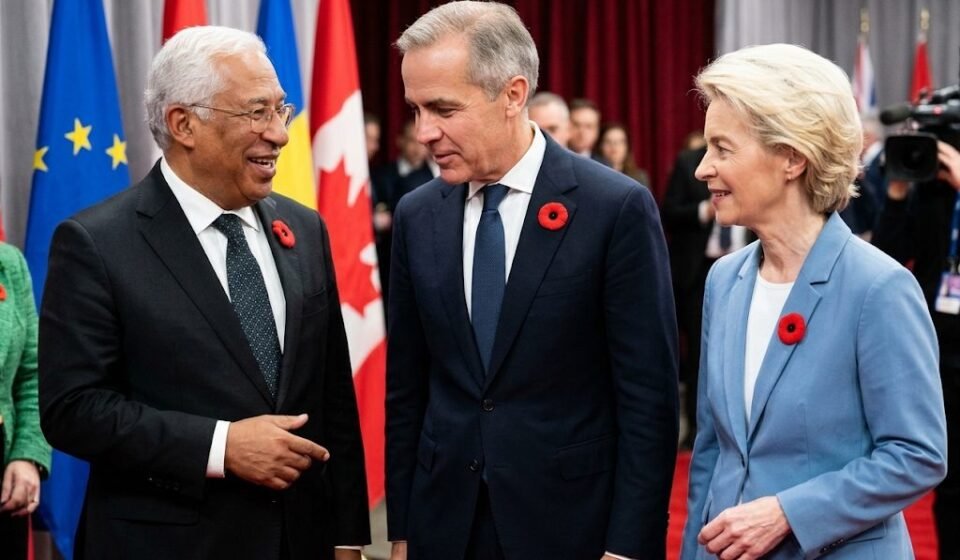
‘Alliance for the Future’: Canada and EU form new alliance to reduce reliance on US

Photo: Collected
Canada and the European Union (EU) have announced a new alliance aimed at reducing dependence on the United States and managing the uncertainty of world politics. The alliance is called the ‘Alliance for the Future’. Other countries that share similar values have also been invited to join it.
A two-day summit in Montreal, Canada, ended on Friday. Canadian Prime Minister Mark Carney and European Commission President Ursula von der Leyen then announced the new partnership. In their view, deeper cooperation between Canada and the EU’s 27 members could create unprecedented stability and opportunity.
Carney said their societies now face new crises, driven by the climate crisis, the erosion of democratic values and the tendency to turn trade into a political weapon. He believes unity among like-minded countries is needed to tackle these challenges.
At the summit, Canada pledged to contribute to the EU’s 90 billion euro loan programme to support Ukraine. Leaders of the two sides also discussed building an integrated market worth tens of billions of dollars in future, reducing barriers to trade and travel, and expanding opportunities for educational exchange.
Amid a trade war with the United States, Carney is looking for new partners. Canada wants to reduce excessive dependence on US companies in key sectors such as defence technology and artificial intelligence. The country’s concerns have grown further over the slowing of Starlink and Starshield services in Ukraine.
As a step towards building alternative technological capacity, Carney highlighted the possible merger of Canadian artificial intelligence company Cohere and Germany’s Aleph Alpha. The new company will be headquartered in Berlin and Toronto, and the Canadian government has announced an investment of up to 1.6 billion Canadian dollars in it. The two sides also signed an agreement on Canada joining Europe’s supercomputing network.
The possibility of making Canada an ‘associate member’ of the EU was also discussed. Several EU member states had raised objections to the idea. The leaders said the structure and powers of such membership would be finalised at the 2027 summit.
European Council President António Costa described Canada as ‘the most European’ of the countries outside Europe.
The summit did, however, spark political controversy in Canada’s Quebec province. The province’s premier and leader of the separatist Parti Québécois, Paul St-Pierre Plamondon, did not attend the summit. He expressed anger after Ottawa did not give him the opportunity to speak publicly at the event. Source: The Guardian
Background
According to a European Commission statement of 24 June 2025, the two sides signed a security and defence partnership agreement at the 20th EU-Canada summit.
According to a La Voce di New York report of 17 September 2026, Ursula von der Leyen proposed making Canada the EU’s first ‘associate member’ in her ‘State of the Union’ address on 16 September; Carney welcomed the aim of the proposal but made no commitment at the time. The same report said US President Trump called the idea ‘ridiculous’ and threatened Europe with heavy tariffs.
A report by The Canadian Press published on BNN Bloomberg on 24 April 2026 said Toronto-based Cohere and Germany’s Aleph Alpha announced their merger that same day; the new company will operate under the Cohere name.
By the numbers
According to a European Commission figure of 24 June 2025, EU-Canada trade has grown by 71 per cent since the CETA trade agreement provisionally took effect in 2017.
At a glance
According to the same BNN Bloomberg report, Cohere and Aleph Alpha were both founded in 2019. Canada’s federal government invested up to $240 million in Cohere in 2024.
Sources
Original report: Bangladesh Pratidin
Background sources: European Commission, 24 June 2025; La Voce di New York, 17 September 2026; BNN Bloomberg / The Canadian Press, 24 April 2026