Government will back students’ proposals for sustainable solutions to local problems: Bobby Hajjaj

Photo: Collected
The government will support the innovative ideas and creative proposals students come up with to identify various local problems and offer practical, sustainable solutions to them. This assurance came from State Minister for Primary and Mass Education Bobby Hajjaj, who is also the member of parliament for the Dhaka-13 constituency.
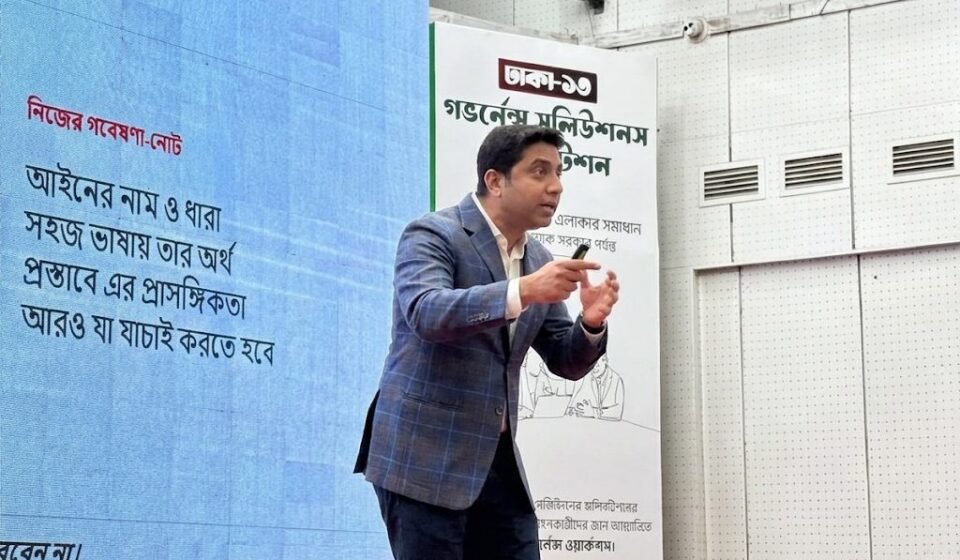
A special workshop of the ‘Governance Solutions Competition’ was held in Mohammadpur in the capital on Saturday. He was the chief guest at the workshop, organised for students from the Dhaka-13 constituency. There he said the talent and new ideas of students must be put to use in solving local problems, and opportunities must also be created for them to take part in state policymaking.
The state minister reminded the students that merely talking about big problems would not do. In his words, they must pick problems for which they themselves can propose practical and effective solutions. How big the problem is, who is affected by it and how deep its impact runs must all be presented with facts and evidence. Field-level surveys, interviews with those concerned, news reports and data from reliable research can be used for this. If needed, various artificial intelligence tools may also be used as an aid.
Bobby Hajjaj stressed the feasibility of the proposed solutions. He said a solution is not good just because it looks attractive on paper; whether it can actually be put into practice must also be considered. Which authorities’ permission and cooperation will be needed, who will be involved, and what kind of manpower, money and other resources are required must be clearly set out in the proposal.
As examples, he referred to controlling traffic congestion in front of schools and managing local canals and waste. In the state minister’s view, any problem calls for long-term and sustainable measures alongside temporary initiatives. The responsibility does not end with a single day’s clean-up drive. People must be made aware, and the participation of everyone concerned in waste management must also be ensured.
He also spoke of identifying who bears the legal, administrative and operational responsibility when designing a solution. His argument was that no initiative lasts long without the consent of the institutions concerned and the public, and without the necessary resources. For that reason, practicality, effectiveness and long-term impact will be given particular weight in the students’ proposals.
The state minister noted that this is not a conventional competition. In his words, through their own thinking and proposals, students are getting the chance to understand the processes of running the state and making policy up close. The three selected teams will be able to work in coordination with the MP’s office to implement their proposals, and also with the state minister’s office if the proposal concerns education. Relevant government institutions and the Jatiya Sangsad will also be involved if necessary.
He also outlined the stages of the competition. The 124 participating teams will first have to submit a detailed written report within a set time, which will be assessed by a seven-member panel of judges. The top five teams selected from there will get the chance to give a 15-minute PowerPoint presentation before a national-level audience and guests. The champion, first runner-up and second runner-up teams will be decided on the basis of the final presentations.
Bobby Hajjaj said, ‘I want the talent and creativity of the students of Dhaka-13 to be put to proper use. We want to show the whole country that if the thinking and innovative power of our students can be properly harnessed, change in the country can begin through them.’
Judges of the competition, members of the organising team, teachers from various educational institutions and the participating students were present at the workshop.
Background
According to a Prothom Alo (English edition) report of 18 February 2026, members of the cabinet of the 13th parliament took oath on 17 February 2026; Bobby Hajjaj’s name was on that list as state minister for the Ministry of Education and the Ministry of Primary and Mass Education.
A Daily Observer report of 16 June 2026 says he was also the chief guest at a National Education Award competition event at the Directorate of Primary Education, where he said the country has many talented students but lacks an environment for developing their skills.
Sources
Original report: Bangladesh Pratidin
Background sources: Prothom Alo (English), 18 February 2026; Daily Observer, 16 June 2026