
Photo: Collected
Indonesia has reduced its natural gas exports to Singapore, deepening a dispute between the two neighbours over smoke spreading from wildfires in the country’s forests.
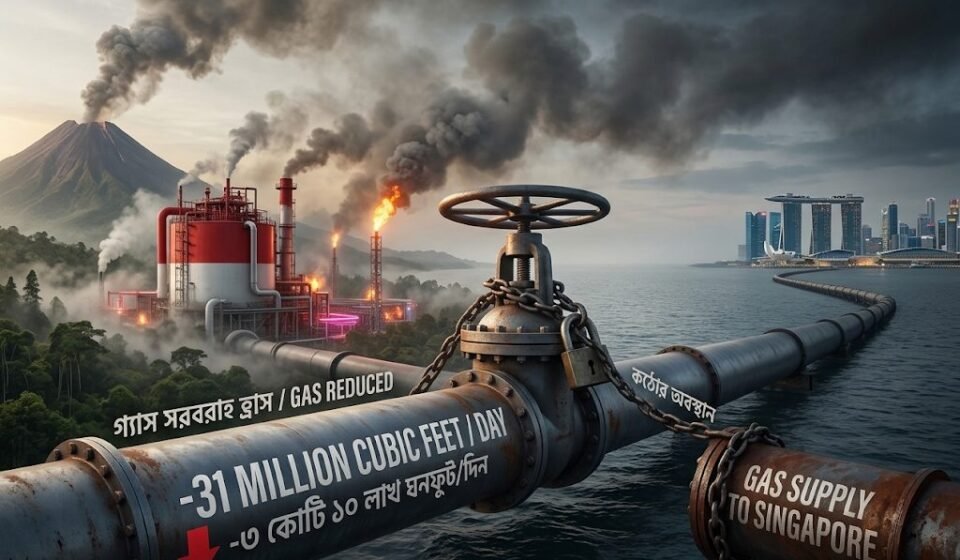
The decision to cut supply took effect on Saturday. In total, 31 million standard cubic feet less gas is going each day. Supply from the Natuna gas field in the Riau Islands has fallen by 15 million cubic feet, and from Sumatra by 16 million cubic feet.
The head of Indonesia’s state agency overseeing the oil and gas sector announced the move in a statement.
The agency is SKK Migas, and its head is Djoko Siswanto. According to a report by news agency AFP, he said the step was taken ‘to maintain the reliability of gas supply for domestic power generation’.
In his words, ‘We will continue to monitor developments in the situation daily.’
For now, only Singapore has to absorb the impact of the decision.
Singapore’s Energy Market Authority claims the reduced volume is not even 2 per cent of the country’s total daily demand. It also has contingency plans in hand to manage the situation.
In a statement to AFP, the authority said, ‘We understand that our importers will take all relevant remedial measures stipulated in the contracts in the event of gas supply disruptions.’
Before cutting supply, Indonesia had issued a series of warnings for a full week.
On Thursday, the country’s energy minister Bahlil Lahadalia said gas shipments could be stopped to countries that do not respect Indonesia.
He made the remark at a ceremony inaugurating a gas facility off the coast of East Kalimantan. According to environment and business news outlet Eco-Business, he said there, ‘I will assess the matter. I will not hesitate to consider stopping exports to countries that disrespect Indonesia.’
The minister added, ‘Our position is clear. Our natural resources will first be used to meet domestic demand. This is now a fight for survival.’
However, he did not specify which country he was referring to.
A day earlier, President Prabowo Subianto ordered the police, public prosecutors and the forestry ministry to investigate the companies behind the wildfires. He also lashed out at those criticising Indonesia abroad.
Prabowo told local media, ‘To a few countries that like to insult the Indonesian nation, I say: in due course we will reveal the names of these companies.’
Singapore has sent legal notices under its anti-haze law to 10 Indonesian companies suspected of possibly playing a role in the wildfires. The country has also pledged to take legal action against those responsible.
Not only that, Singapore’s stock exchange authority has asked seven listed agricultural producers whether they have any link to the wildfires.
About 95 per cent of Singapore’s total electricity comes from natural gas. According to the country’s trade ministry, Singapore imports gas from Indonesia mainly through pipelines, and these supply contracts will expire towards the end of 2028.
More than half of the gas Singapore imported in 2024 was liquefied natural gas. A second terminal is being built in the country to store and supply this gas.
According to data from the US Energy Information Administration, 145.3 billion cubic feet of gas went from Indonesia to Singapore in 2024.
According to deforestation monitor Nusantara Atlas, more than 1.9 million hectares of forest burned in wildfires over the nine months from January to September this year.
Indonesia’s health ministry said more than 333,470 people in seven provinces have suffered from acute respiratory illness since mid-August.
The smoke has also reached Malaysia and East Timor. ASEAN, the Southeast Asian regional bloc, has called a meeting on the crisis.
Malaysian Environment Minister Arthur Joseph Kurup said Malaysia has the right to demand effective action from Indonesia.
He also said his country would raise the haze issue at the ASEAN meeting in the Philippine capital Manila.
Anger is growing on both sides of the border.
Thousands of students have taken to the streets in various parts of Indonesia in protest at the government’s role. On Friday, more than 500 students demonstrated in front of the Central Kalimantan provincial governor’s office. They demanded that the wildfire situation be declared a national disaster.
Meanwhile, Indonesia’s head of government communications, Siahganda Naingolan, remarked that the oxygen in the air of Singapore and Malaysia comes from Indonesia’s forests. Following that remark, some Malaysian consumers have started boycotting Indonesian products.
Source: The Independent
Background
This is not the first time a cut in pipeline gas to Singapore has been discussed. SKK Migas head Djoko Siswanto said in April 2025 that there was a target to reduce pipeline exports to Singapore by 30 million standard cubic feet a day in June that year, Gas Processing News reported on 9 April 2025, citing Reuters.
Indonesia’s Ministry of Energy and Mineral Resources said in a notice on 6 February 2020 that pipeline gas to Singapore would be stopped from 2023 to meet domestic demand.