Kazi Sabyasachi raised recitation of Nazrul’s poetry to the height of modern art

Photo: Collected
In his short life, Kazi Sabyasachi elevated the art of recitation and elocution to the status of a modern and aesthetic art form. In particular, he created a distinct place for himself in the art of Bangla recitation by reciting the poems of National Poet Kazi Nazrul Islam. His role was also unique in establishing recitation as an important medium for taking poetry to people of different strata of society.
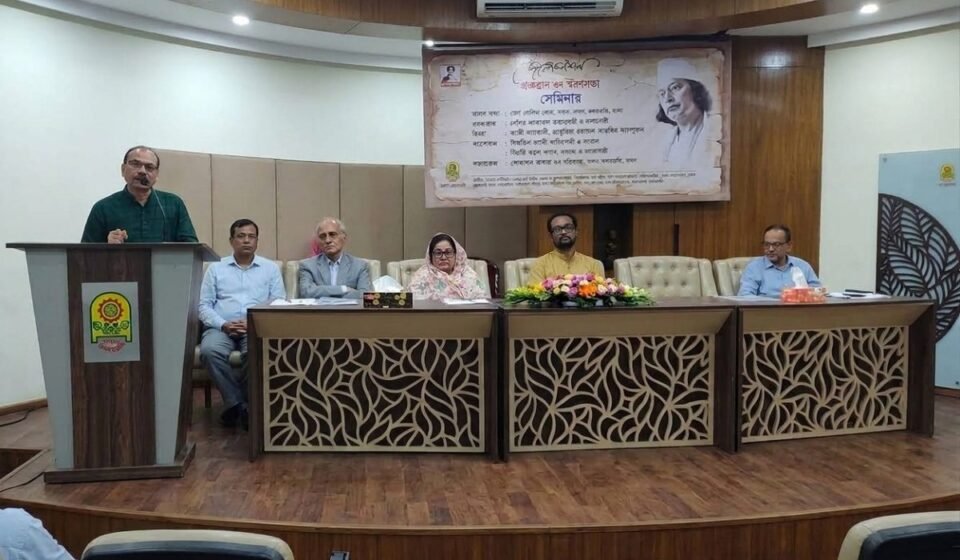
Speakers said this today at a seminar titled ‘Kazi Sabyasachi: The Leading Spirit of Modern Nazrul Recitation’, organised on the occasion of ‘Nazrul Year’ at the Poet Shamsur Rahman Seminar Hall of Bangla Academy.
Reciter and lawyer Nasim Ahmed presented the keynote paper at the seminar. Singer, organiser, and chairman and member of the trustee board of the National Poet Kazi Nazrul Islam Institute Khilkhil Kazi and recitation researcher and elocutionist Nimai Mandal took part in the discussion.
Bangla Academy Secretary Dr Md Selim Reza delivered the welcome address. The academy’s Director General Professor Mohammad Azam presided.
In the paper, Nasim Ahmed said that in his short life Kazi Sabyasachi had elevated the art of recitation and elocution to the status of a modern and aesthetic art form. His voice was full, vigorously masculine, deep as thunderclouds and honeyed. He will long be remembered as the leading figure worth following in the modern art of recitation.
He said Sabyasachi recited not only Nazrul’s poems but also the poems of other poets with extraordinary skill. Although he gained wide popularity as a reciter of Nazrul’s poetry, his skill in reciting the poems of other poets was also enviable. He had taken recitation from the homes of the middle class to ordinary people in fields and open grounds.
Nasim Ahmed said Kazi Sabyasachi, the leading spirit of Nazrul recitation, will remain luminous for a long time as the pioneer of the modern art of recitation in the world of elocution, recitation and the art of sound. He will also be remembered with respect as a promoter of the aesthetic melody of sound in Nazrul’s literature.
Khilkhil Kazi said she grew up from childhood listening to the recitation of her father Kazi Sabyasachi. Sabyasachi used to recite poems in front of her grandfather Kazi Nazrul Islam, and Nazrul would listen to it silently. After coming to Bangladesh, Nazrul lived in a beautiful house with a large garden. He loved flowers very much.
Sometimes her mother would take her to that garden. At times Nazrul too would go to the garden alone, sit beside the flower plants and mutter something.
She said Kazi Sabyasachi is an example of how popular a person can become by loving recitation. He won people’s hearts with recitation and brought this art close to people’s hearts. He showed that recitation too can be taken up as a profession.
Khilkhil Kazi further said her father recited very well. At a programme in Kolkata on the occasion of the birthday of Kabiguru Rabindranath Tagore, everyone present had requested Sabyasachi to recite the poem ‘Bidrohi’, written by her grandfather Kazi Nazrul Islam. There are many such memories.
Dr Md Selim Reza said Kazi Nazrul Islam’s poetry is a powerful expression of rebellion, equality, humanity, love, non-communalism and the yearning for freedom in Bangla literature. Just as the language of his poetry is spirited, its rhythm, sound and arrangement of words are especially suited to recitation.
Professor Mohammad Azam said Kazi Sabyasachi presented recitation keeping in consideration the characteristics of Nazrul’s poetry in the context of history. He had internalised Nazrul’s poetry from childhood. As a result, a creative connection developed between the characteristics of Nazrul’s poetry and Sabyasachi’s recitation.