

Netanyahu and Eisenkot at odds over hung parliament as Herzog urges compromise to avoid new election

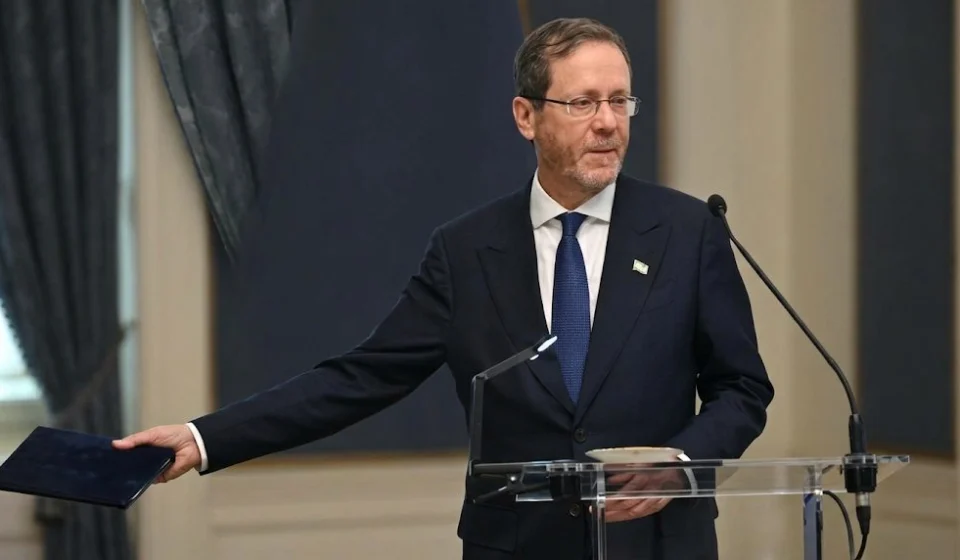
Photo: Collected
Israeli Prime Minister Benjamin Netanyahu on Wednesday pressed harder on his allegation of foreign interference in last week’s election, while the country’s President Isaac Herzog called for political compromise.
AFP reported from Jerusalem that President Herzog has begun talks with party leaders more than a week after the first election held in Israel since the 7 October 2023 Hamas attack. It is he who will decide whether Prime Minister Benjamin Netanyahu or his rival Gadi Eisenkot gets the first chance to form a government in the deeply divided country.
Eisenkot, who has the backing of a major Arab party, has pledged that if he becomes prime minister he will rise above partisan divisions and deepen the US-Israel partnership. He has also promised to work with President Donald Trump to bring stability to the Middle East.
Netanyahu alleged, ‘There is serious suspicion that foreign states spent huge sums of money to influence the results of Israel’s election.’
Netanyahu has taken an aggressive stance against Arab-majority parties; if these parties unite, the way could open for Eisenkot to form a government. He has highlighted the arrest of several people with envelopes stuffed with cash on election day, although the authorities describe these as isolated local incidents. Netanyahu has also alleged that some leaders took money from Qatar; similar allegations have been made against his own aides.
Neither side won a majority in the 120-seat parliament in the 27 October election. In this situation, Herzog said both sides must accept that ‘not all promises and commitments can be fulfilled’. He also called for a new election to be avoided.
Herzog said, ‘In the current reality, after an election with no clear winner, I call for creative and out-of-the-box thinking, courage and goodwill, so that the State of Israel is the winner.’
Support for parties representing the Arab minority rose significantly in this election. The descendants of Palestinians who remained there after Israel’s founding in 1948 make up most of the country’s Arab minority. They have often voiced anger at the harsh rhetoric and actions of Netanyahu’s hard-right government.
Without naming any leader, President Herzog, whose role is usually ceremonial, said he has ‘deep respect’ for the Arab minority, which makes up about 20 per cent of Israel’s total population. He said, ‘I condemn the obscene and racist remarks we have heard recently.’
US-Israel partnership
Eisenkot, a former army chief who has pledged to end Netanyahu’s long and divisive rule, has promised to ‘rebuild and deepen’ Israel’s partnership with the United States. He also spoke of strengthening the bipartisan support that has long been the foundation of this relationship.
On the social media platform X he said, ‘I look forward to working closely and constructively with President Trump and his administration.’ He added, ‘Together we can advance shared security interests, strengthen regional stability and open new paths to prosperity for the peoples of the Middle East.’
Eisenkot’s remarks came amid criticism after Trump announced he had agreed with Netanyahu to end about $4 billion a year in US military aid by the end of this year.
Ra’am, the main Arab-Israeli party, has formally backed Eisenkot to form the new government. The party made the announcement ahead of its meeting with President Herzog.
Eisenkot has warned Netanyahu against starting a new war against Iran together with Trump. In his view, such a war could give Netanyahu the chance to form a national unity government, or open the way to stalling until a new election.
Opposition lawmakers say the Democrats’ big win over Trump’s Republicans in Tuesday’s US midterm elections has strengthened the case for removing Netanyahu from power. Amid anger over the widespread destruction in the Gaza war, the Democrats have pledged to take a tougher line on Israel.
Yair Golan, head of the most left-wing party in the opposition bloc, said, ‘If Netanyahu and (Itamar) Ben-Gvir remain in power, Israel could head towards international sanctions, international isolation and confrontation with the United States.’
No evidence of irregularities in the election
The Central Elections Committee said that, in response to the allegations, it audited the vote counts of 9,069 polling stations and found no evidence that could call the legitimacy of the results into question. The committee, whose make-up reflects the outgoing parliament, approved the results by a vote of 15-2; 14 members abstained.
Ultranationalist National Security Minister Ben-Gvir, known for inflammatory remarks in favour of increasing the suffering of Palestinians, said his party has not accepted the election results. He also called for the arrest of Arab-Israeli party leaders.
Several Israeli media outlets reported that the authorities are investigating Arab lawmaker Ayman Odeh over allegations of taking foreign money. He is a member of the largest Arab political alliance, the ‘Joint List’. In a statement, the alliance condemned the move as ‘political harassment’.
Eisenkot accused the prime minister of trying to ‘weaken’ Israel’s democracy and of stirring up public hatred against elected representatives. Marking the anniversary of the assassination of Prime Minister Yitzhak Rabin, who was killed in 1995, he said, ‘We will not allow the State of Israel to be dragged far beyond the bounds of democratic conduct into a dark abyss.’
President Herzog will first hold talks with the political parties over two days. He will then give one candidate 28 days to form a government; if necessary, this period can be extended by a further 14 days.
Background
According to an analysis by Rosa & Roubini Associates dated 25 August 2026, former army chief Gadi Eisenkot founded a new party named ‘Yashar’ on 30 June.
By the numbers
According to the Times of Israel’s count, after just over 55 per cent of ballot boxes had been counted, the Likud-led bloc stood at 56 seats and the opposition bloc led by Eisenkot at 49 — Al Jazeera reported this on 28 October.
Sources
Original report: BSS
Background sources: Rosa & Roubini Associates, 25 August 2026; Al Jazeera, 28 October 2026