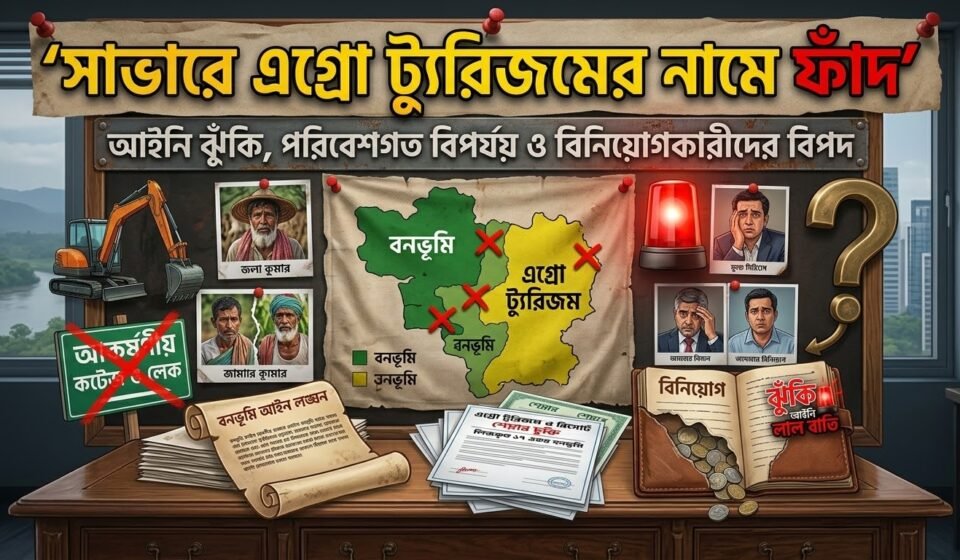
Destroying the environment on the pretext of building Sonar Bangla: so-called resort devouring forest and farmland in Savar’s Kamalpur

Photo: Collected
A few individuals have taken an initiative to set up an establishment named ‘Agro Tourism and Resort’ on 17 acres of forest land at Kamalpur in the Chhoto Kaliakair area of Savar. Although, seen from outside through their publicity, it appears to be an attractive and environment-friendly investment, serious legal and environmental risks lie hidden within it. An analysis of the overall information shows that the project is being built in violation of environmental law and the government’s land policy for commercial interests, which may expose investors to major financial losses in the future.
The main negative and risky aspects of the project are set out below:
1. Legal validity of the lease of Forest Department land and major risk of eviction
Violation of forest law: According to the constitution of Bangladesh and the prevailing forest law, using government forest land or land under a sub-beat for a commercial resort, tourism or a project serving private interests is completely illegal.
Lack of transparency in the terms of the agreement: Forest Department land is generally given on the basis of temporary agreements for social forestry or specific environmental purposes. A claim to use the land there in the name of any member or private proprietor on the pretext of a commercial resort or animal husbandry will not stand up to legal scrutiny. The government can cancel this lease at any time and take back possession of the land, which will put the project’s entire investment at risk.
2. Conversion of farmland to non-agricultural use and environmental damage
The plan that has been made to buy adjacent privately owned farmland for building the resort and cottages is completely contrary to the country’s ‘Agricultural Land Protection Act’. Local food production and the natural balance are being destroyed by building permanent structures on fertile farmland.
Ecosystem disaster: The area adjoining Birulia and the forest beat in Savar is known for its natural lakes, forests and farmland. The crowds of hundreds of tourists every day, waste disposal and noise pollution here will put local biodiversity, animals and birds, and the forest under serious threat.
3. Lack of transparency
Although it is said that investment will be collected in phases by selling only 20 shares, there is no clear and lawful framework for the project’s total budget, the method of distributing dividends or the transfer of land.
Fear of fraud against investors: It is not possible to transfer ownership of leased forest land to investors. As a result, if the project is shut down over any legal complication, ordinary shareholders will not get their money back. Running such a big resort relying only on a small amount of purchased farmland is an extremely short-sighted and risky business model.
4. Wrong message and tourism in disguise
The report says local farmers will benefit through tourism. But in reality, if an artificial resort is built by occupying forest and farmland, local farmers become cut off from their main livelihood and land.
Harm to agriculture: Normal cultivation will be disrupted by the noise of a modern resort and the movement of tourists, and the natural environment of the local village will be destroyed forever.
All in all, it can be said that this agro tourism project at Kamalpur beside the Savar forest beat is an anti-environment initiative surrounded by legal complications. If a resort is run on forest land, it may face a government drive at any moment. Buying shares or investing in this project without adequate legal approval, environmental impact assessment (EIA) clearance and a clear financial guarantee is extremely risky.