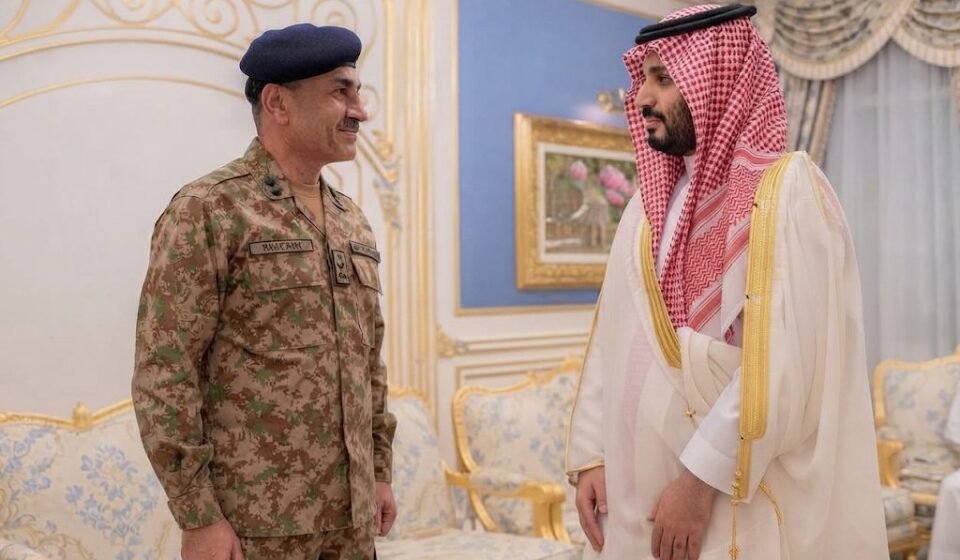

Photo: Collected
In 2015, during the Yemen crisis, Pakistan’s national parliament had taken a unanimous decision in favour of not joining the Saudi-led coalition. After a long 11 years, a completely opposite picture is now being seen. A fresh debate has arisen over the country’s domestic politics and defence policy centring on the decision to deploy troops anew in the regional military alliance led by Saudi Arabia.
This time the defence establishment led by current Field Marshal Asim Munir has agreed to quickly send additional military strength to Riyadh, completely bypassing parliament. This has made it even clearer that the army has absolute control and sole authority over Pakistan’s foreign and defence policy.
Pakistan, Saudi Arabia and Turkey had signed a trilateral defence agreement last August. Against the backdrop of the recent series of attacks carried out by Yemen’s Iran-backed Houthi rebels, the agreement was formally brought into effect on Monday. According to a special report by news agency Reuters, through a new constitutional amendment army chief Field Marshal Asim Munir has been given the responsibility of supreme commander of all three of the country’s forces, naval, land and air, until 2030. Along with that he has been given lifelong rank and full legal immunity from any kind of criminal prosecution.
Analysts think this decision to send soldiers to Riyadh by sidestepping parliament is essentially a clear indication that the military’s absolute dominance in the country’s domestic politics is growing. The decision has come at a time when Pakistan Tehreek-e-Insaf, the party of jailed former prime minister Imran Khan, is alleging that the army is controlling the country’s politics; with this claim the party is also conducting a protest march towards the capital Islamabad. Commenting on the situation, Michael Kugelman, senior fellow for South Asia at the Atlantic Council, said there were many times in the past when Pakistan’s parliament voted against sending troops and the military abided by that decision. But the present situation and political reality have entered a completely different era.
Pakistan’s information ministry has confirmed the defence agreement and the troop deployment. The ministry said the process of forming the alliance and sending troops was completed in compliance with all necessary government rules and procedures. However, it did not make clear whether any consent of the cabinet or parliament had been taken for this decision. Instead, describing the whole matter as part of operational secrecy, the ministry refrained from disclosing detailed information.
This move by Islamabad may also bring new risks for the country’s diplomatic relations. This is because Pakistan is currently playing an active role as a mediator with Iran in the US-led effort to resolve the Yemen crisis. In this situation, if Pakistani troops get directly involved in fighting against the Houthis, a major rift or severe deterioration could appear in the country’s diplomatic relations with Tehran.
The Houthi rebels have been imposing a ban on the movement of Saudi Arabia-bound ships in the Red Sea since last July. Since then they have attacked several oil tankers and important energy installations. Last week the Saudi-led coalition even claimed that the Houthi rebels had attacked a power plant in Madinah; the plant supplies electricity to the Prophet’s Mosque. The Houthi authorities, however, have completely denied the truth of this claim.
Amid this crisis, Asim Munir met his Saudi and Turkish counterparts at an emergency meeting in Riyadh. All three countries strongly condemned possible attacks on Makkah and Madinah. At the same time they agreed to provide the previously determined military capabilities and ensure rapid troop deployment in line with their respective national laws. However, no information has been disclosed on how many soldiers will take part in this operation, what exactly their mission will be, or what the cost and duration of the deployment will be.
According to political analysts, the main difference between 2015 and the present situation lies not in the law but within the political structure. The central government’s authority over the armed forces was upheld in the country’s constitution then and still is. But historically in Pakistan, even when a democratic government was in power, the key to defence and foreign policy remained in the hands of the army headquarters. And Asim Munir has managed to build a far stronger and more influential position inside the country than his predecessors.
The news agency tried to contact the ruling Pakistan Muslim League-Nawaz and its coalition partner the Pakistan Peoples Party, but they declined to make any comment. On the other hand, Zulfi Bukhari, spokesperson for Imran Khan’s party PTI, did not make clear whether his party supports the troop deployment. However, he said that debate and decision-making on this extremely important matter should have taken place with political wisdom and awareness.
The original draft or text of the ‘Makkah Joint Defence Agreement’ has not yet been made public. In fact, it is a continuation of a joint agreement signed in 2025. Under that agreement, about 8000 soldiers made in Pakistan had already been sent to Saudi Arabia by May this year. The government side claims that it was mainly the trust and coordinated relationship between the field marshal and the prime minister that worked behind the constitutional changes recently brought by Prime Minister Shehbaz Sharif’s government.
Andreas Krieg, associate professor at King’s College London, described the situation as a ‘recurring cycle’. According to him, international allies and partners are viewing Pakistan’s military as a kind of indispensable factor, and that is further strengthening the army’s authority inside the country. He noted that foreign partners may not have created this imbalance of civil-military power in Pakistan, but they are continually facilitating or encouraging the system. A system of governance that has no strong institution to maintain the balance of power may be highly adept at entering into a commitment, but if the price has to be paid for it later, it becomes extremely difficult for them to correct or manage it.
Source: Reuters