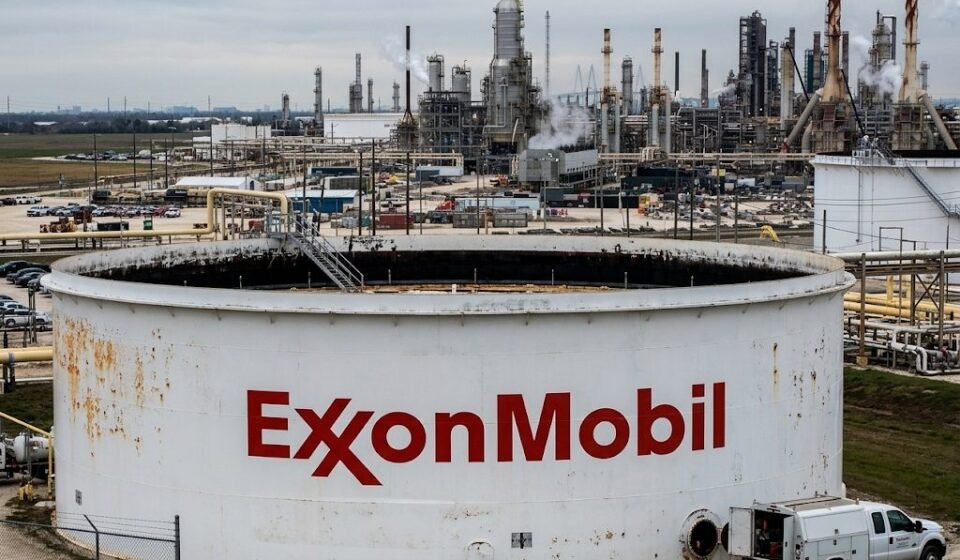
US refineries ramp up output amid energy crisis, ExxonMobil and Chevron profits more than double

Photo: Collected
The conflicts involving Russia and Iran have squeezed fuel supplies on the global market. In this situation, US oil companies have moved to increase the capacity of existing refineries as well as restart some refineries that had been shut for a long time.
The aim is the same: to extract more fuel from the same amount of crude oil.
News agency AFP reported this.
Darren Woods, chief executive officer (CEO) of ExxonMobil, the top US oil company, said yesterday (Friday) that their refineries outside the Middle East have reached record capacity in fuel production. In particular, 100 per cent utilisation of crude oil has been ensured at the refineries on the US Gulf Coast.
Meanwhile, petrol prices in the US remain above $4 a gallon. Diesel prices are also close to $6 a gallon, near an all-time high.
In a statement, Woods said, ‘In the third quarter, we continued our efforts to meet global energy demand.’
Woods believes it may take much of next year, or even longer, for global energy supplies to return to near normal.
Chevron, another major US oil company, said the volume of crude oil processed at its refineries hit a record in the third quarter of this year.
Chevron’s chief executive officer Mike Wirth said, ‘We are making new investments to bring more energy to a supply-constrained market.’
However, according to the company’s vice chairman Mark Nelson, about 10 per cent of total oil refining capacity worldwide is still shut.
In his view, once refineries are back at full capacity and exports rise, refining margins will eventually come down; but it will take some time to reach that stage.
Third-quarter financial reports released on Friday show that the profits of both ExxonMobil and Chevron more than doubled compared with the same period last year. Oil companies are reaping big financial gains from higher crude oil prices on the global market and rising refining margins.
On the other hand, the abnormal rise in fuel prices and the supply crisis have sparked protests in various parts of Asia, Latin America and Europe.
Energy sector officials believe Iran has a role behind the fall in output at refineries in various Asian countries. In their view, Iran’s obstruction of energy shipments through the Strait of Hormuz has reduced the supply of key crude oil on the global market.
Damage to various Russian oil refineries from Ukrainian drone attacks has further complicated the global energy supply situation. According to consultancy KPMG, Russian refineries accounted for 6.5 per cent of total global oil refining capacity in 2025.
Energy research firm Rystad Energy warned in a report published on 21 October that if the production situation continues to deteriorate, Russia may have to import petrol and diesel in 2027. In other words, the country is at risk of turning from a fuel exporter into an importer.
Russian Deputy Prime Minister for energy Alexander Novak told a state television journalist on Friday that Ukraine has again started attacking Russian oil facilities. The latest attacks damaged three of the country’s oil refineries and a gas-chemical facility.
According to Friday’s financial reports, ExxonMobil’s profit in the third quarter of this year stood at $15.4 billion, compared with $7.5 billion in the same period last year.
Chevron’s profit rose to $9.9 billion; in the same quarter last year it was $3.5 billion.
However, runaway petrol and diesel prices have put US President Donald Trump’s administration under political pressure. To ease the burden of higher prices on consumers, the administration is pressing oil companies to increase production and supply.
Against this backdrop, US oil companies have announced various plans to increase production capacity.
US oil refiner Valero Energy said on Friday it has agreed to buy a long-shuttered oil refinery in Houston from LyondellBasell for $325 million. It plans to restart initial operations at the refinery by the end of 2027.
Background
Transport Topics, citing Bloomberg, reported on 1 June 2026 that the Strait of Hormuz was effectively closed after the war between the US-Israel and Iran began on 28 February 2026; before that, about 20 per cent of the world’s oil and gas passed through this route.
According to a Hydrocarbon Processing report of 10 February 2025, LyondellBasell had at that time permanently shut the Houston refinery, which had a capacity of 263,776 barrels per day.
By the numbers
According to data published by the US Energy Information Administration (EIA) on 20 October 2026, the retail price of regular petrol in the country on 19 October was $4.284 a gallon, $1.265 higher than a year earlier; diesel was $6.276, up $2.656 in a year.
Sources
Original report: BSS
Background sources: Transport Topics (Bloomberg), 1 June 2026; Hydrocarbon Processing, 10 February 2025; US Energy Information Administration (EIA), 20 October 2026