
Photo: Collected
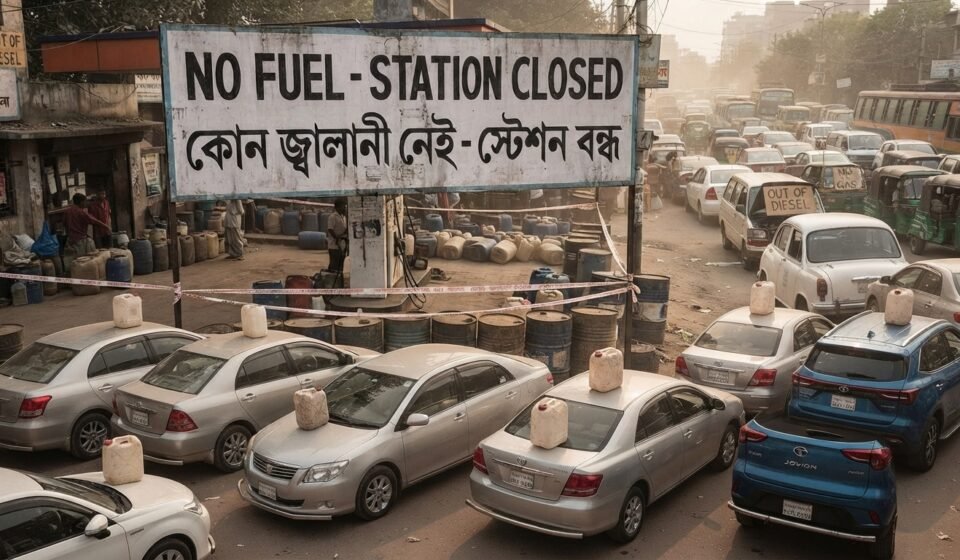
Although new residential and commercial areas have sprung up one after another in the eastern part of the capital, fuel supply infrastructure has not expanded in proportion. As a result, residents of the residential areas adjoining the 300 Feet road and Purbachal have to go to filling stations several kilometres away to refuel their vehicles. Besides costing extra time and money, this is generating additional traffic on the way to and from refuelling. The effect is falling on important nearby roads, including Kuril and Khilkhet.
Abdullah Al Mamun, a resident of a housing project adjoining the 300 Feet road, regularly has to go to filling stations at Kuril or on Airport Road to refuel his car. He said that even though he sets off to get fuel with a few litres in the car, a significant amount of fuel runs out on the way itself.
He said, ‘Two days ago I went out to get fuel with a few litres in the car. Half the fuel was gone just getting there. If for some reason I had not been able to get fuel, the rest might have run out too and I would have been stuck on the road. If there were enough filling stations nearby, I would not have to go so far.’
Talking to local residents, it was learnt that a huge number of people live in various residential areas, including Bashundhara, Police Housing Society, Navy, Swadesh Swarnali, Swadesh Sunvalley and United, from Kuril along the 300 Feet road up to the Purbachal project. To collect fuel for their vehicles, residents of these areas have to depend on comparatively distant filling stations.
On the other hand, there are several filling stations within an area of only about one and a half kilometres from the Gulshan-Tejgaon Link Road to Satrasta. In other words, while the density of filling stations is high in one part of the capital, locals allege that fuel supply arrangements in the fast-expanding residential areas of the eastern part are low compared to demand.
Residents claim that as there are not enough filling stations in these areas, several thousand vehicles have to travel extra distances every day just to collect fuel. On one hand this is increasing fuel costs, and on the other valuable working hours are being wasted. In addition, traffic congestion is also increasing on the roads concerned because of unnecessary vehicle movement.
According to information given by locals, to collect fuel some vehicles from this area have to travel an extra distance of more than 10 kilometres to Kuril, about 13 kilometres to Khilkhet and about 18 kilometres to Jolshiri.
As a result, part of the fuel consumed in going to collect fuel is effectively being spent on fetching the fuel itself. In some cases the trip takes up to 30 to 60 minutes of extra time.
The impact of this situation is not confined to private cars alone. Various types of vehicles, including public transport, goods vehicles, ride-sharing cars and motorcycles, are also making extra trips on these roads to collect fuel.
Locals fear that if the residential and commercial expansion of eastern Dhaka continues in this way, about three to four lakh vehicles may ply in this region every day in the future. If there are no adequate local fuel supply arrangements at that time, the pressure of additional traffic will increase further. Those concerned also think this pressure may rise further once the Mohakhali bus depot is fully relocated.
The financial and environmental impact of the additional traffic is not small either. According to calculations, if 50,000 vehicles travel an average of 7 extra kilometres every day to collect fuel, the total additional travel comes to about 3 lakh 50 thousand kilometres a day.
Assuming an average fuel consumption of 0.10 to 0.12 litres per kilometre for a vehicle, about 35,000 to 42,000 litres of additional fuel may be needed every day for this extra travel.
In other words, the lack of adequate filling stations locally is not only causing traffic congestion and a loss of working hours, but a huge amount of fuel is also being consumed additionally every day. There is a fear that in the long term its financial value will reach a significant figure.
At the same time, carbon emissions and air pollution are rising as a result of burning extra fuel. The level of noise pollution may also increase because of the additional pressure of vehicles. So the issue is not confined merely to the convenience or inconvenience of collecting fuel; questions of urban management, the environment and traffic congestion are also tied up with it.
Local residents allege that during the Awami League government’s tenure, the process of setting up new filling stations was stopped through a special order. However, the process of setting up LPG stations was kept going during that same period.
They claim that, as the scope for setting up new filling stations became limited at that time, infrastructure was not subsequently built in keeping with the fuel demand of the fast-expanding residential areas.
On one hand, new residential areas have sprung up, the population has grown, and the number of private vehicles has also increased. On the other, no opportunity was created to set up adequate filling stations taking into account the future fuel demand of these areas. That is why residents now have to depend on distant stations.
In this situation, locals have demanded an integrated study taking into account the current and future fuel demand of Bashundhara Residential Area and the surrounding residential areas.
In their view, filling stations need to be set up in a planned manner at no fewer than two to three suitable locations, taking into account, through the study, the number of vehicles, the population, future residential and commercial expansion and road capacity.
However, in setting up stations, importance must be given to ensuring fire safety, environmental clearance, urban planning, road capacity, arrangements for vehicle entry and exit, and adequate space for waiting vehicles.
Those concerned think this requires a coordinated initiative by the Ministry of Power, Energy and Mineral Resources, Bangladesh Petroleum Corporation (BPC), Rajuk, the Roads and Highways Department, the city corporation and the Department of Environment.
Mohammad Ali, a resident of Police Officers’ Housing Society, said, ‘If filling stations are set up in a planned manner, the need to go far to get fuel will fall. This will make it possible to reduce unnecessary vehicle movement, the waste of fuel and money, and the loss of people’s working hours.’
Tajul Islam, a resident of the United City area, said, ‘If needless vehicle movement for collecting fuel can be reduced, the extra pressure on the Kuril-Khilkhet area will ease. At the same time, it will also be possible to keep air and noise pollution under control.’
He said, ‘Rapid residential and commercial expansion is taking place in this region of eastern Dhaka. Demand for vehicles and fuel will rise further in the future. So the necessary infrastructure needs to be built right now, taking future demand into account.’
In this regard, a senior official of Bangladesh Petroleum Corporation (BPC), speaking on condition of anonymity, said that the process of approving new petrol pumps has been kept suspended through a special office order under the existing policy. The policy in this regard was formulated around 2019-20.
He further said the government has asked the BPC for a draft policy for approving new petrol pumps and filling stations. Although a draft policy was earlier sent to the ministry by the BPC, it has been sent back to the BPC for further scrutiny.
According to the BPC official, the draft policy has been discussed with various stakeholders and their opinions have been taken. It is currently in the final stage of scrutiny; the process of finalising the policy may be completed soon. In his view, this is the main reason why approval of new filling stations remains suspended.
Urban expert Professor Dr Adil Mohammed Khan said urban infrastructure needs to be planned on the basis of the habitation and needs of the people of a particular area. If there is no coordination in planning, it is the residents who later have to bear its negative effects.
He said, ‘People’s habitation is increasing; but arrangements for collecting the necessary fuel are not being made, or cannot be made, in that proportion. As a result, people have to go to other areas, and this is creating extra pressure on those areas too.’
According to those concerned, it is urgent to plan fuel supply infrastructure right now, keeping in mind the future population and number of vehicles of the fast-expanding residential areas of eastern Dhaka. Otherwise, just as the tendency to travel extra distances to collect fuel will go on, the pressure of traffic congestion, fuel wastage and environmental pollution may also increase further.