
Photo: Collected
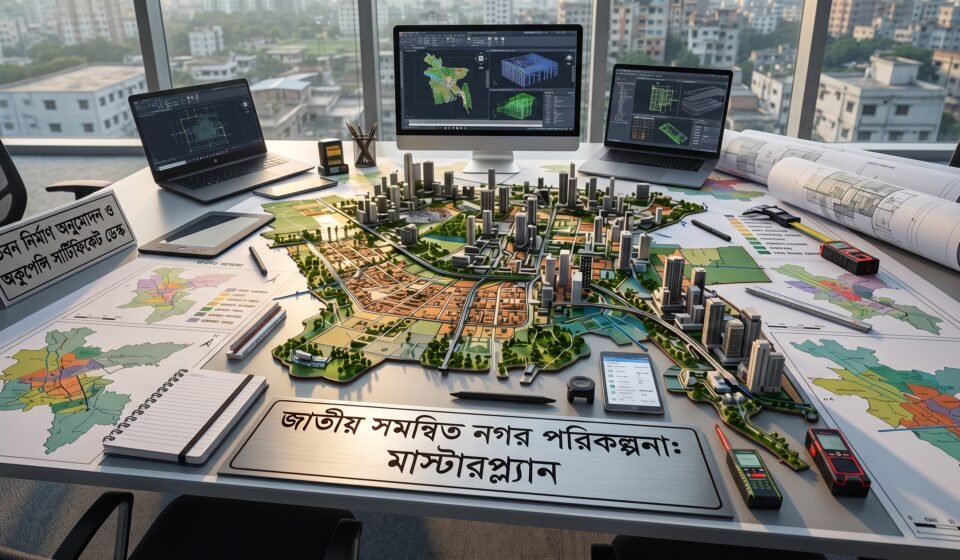
The government has taken an initiative to prepare master plans from the country’s big cities down to the upazila level, with the aim of bringing unplanned urbanisation and housing under an integrated plan. Alongside this, the system of approving building construction by coordinating architectural, structural and electrical plans together, and of issuing occupancy certificates after construction is completed, is also being strengthened.
Housing and Public Works Minister Zakaria Taher disclosed the matter. He said several tasks have already been started to build urban and housing systems in a planned manner. Efforts are now under way to bring everything – architectural, structural and electro planning – under one comprehensive plan in a coordinated way.
In his view, after a building’s design is approved, it also needs to be ensured whether the approved design was properly followed during construction. To that end, when a building’s occupancy certificate is issued, arrangements will be made to have the designers concerned certify whether the building has been constructed in compliance with the approved plan.
Zakaria Taher said a number of tasks have been carried out over the past seven months on urban development and housing management under the prime minister’s directives. Proposals received from the various parties concerned have also been considered with importance and initiatives have been taken to implement them.
The housing and public works minister said the Urban Development Directorate (UDD) has adopted a 10-year plan for the first time. Through this plan, planned urban development work will be taken forward in phases across the country. Initially, emphasis is being given to the metropolitan cities. After that, an initiative will be taken to prepare realistic master plans for every area, from big cities to upazilas.
He also said zoning will be done by determining what kind of structures, residential areas, commercial areas or other uses there will be in which place, considering the needs and potential of each area.
In his words, carrying out development activities without a master plan is much like shooting four arrows at one target. One of them may perhaps hit the target. But in the case of planned development, there is no scope to proceed in this way. Work has to be done on the basis of a specific plan. That is why, besides further strengthening the UDD, work is being done giving priority to this department.
The minister further said having adequate and reliable data is extremely important for proper planning. But the last population census held in the country was a long time ago. For this reason, a new, appropriate census is needed to know the current situation and the real picture of population, settlement, housing and urbanisation. On the basis of the data obtained from it, future planning can be done more effectively.
Referring to the approval of building construction, he said building designs have been approved through Rajuk in various areas under Rajuk and the Ministry of Housing and Public Works, including the capital’s Dhanmondi. Yet in many areas outside these, buildings have been erected without an approved plan. Work is now under way to identify those buildings.
He said long-term initiatives have also been taken regarding the environment of the capital’s Gulshan, Banani, Baridhara and Hatirjheel areas. Zakaria Taher also said the prime minister has sat in meetings with those concerned six times on this.
Housing and Public Works Minister Zakaria Taher said there are about 4,300 houses in the Gulshan, Banani and Baridhara areas. The septic tanks and soak wells that were supposed to be in place at the time of construction were not built in an estimated 70 to 80 percent of the houses. Similarly, many renowned developers have also constructed buildings but did not arrange a sewage treatment plant, or STP, for treating waste.
He said besides making those concerned aware of this, meetings have been held several times with the Gulshan, Banani and Baridhara societies. The Rajuk chairman, the state minister for housing and public works, the state minister for the Local Government Division, the managing director of Dhaka Wasa and others concerned took part in these meetings.
Zakaria Taher said areas like Gulshan and Baridhara are important and specialised areas of the country. If even the lake water and environment of these areas cannot be kept in order, the task of improving environmental management across the country will become more difficult.
He said there are initiatives on the part of the government in urban development, and the prime minister’s directives on the matter are also being received. The government elected by the people is keen to accept any necessary and effective advice it receives for the welfare of the country. In this regard, he called on all concerned to cooperate.
Zakaria Taher also spoke of forming new development authorities with the aim of strengthening urban management. He said six new development authorities modelled on Rajuk have been formed in Mymensingh, Sylhet, Cumilla, Narayanganj, Rangpur and Barishal in the past seven months. There were four more development authorities before this. Such initiatives are being taken in phases in other areas as well, including Bogura.
The housing and public works minister said if there is no development authority in an area, the responsibility for approving and implementing designs often falls on the city corporation itself. As a result, there is a risk of a shortfall in effective checks and balances. Examples of this exist in various areas of Dhaka too. In some areas, including Bosila, there are even instances of building designs being approved from the union level. An initiative has been taken to bring these matters under an overall legal framework.
He said work is under way to frame new rules regarding buildings constructed without an approved design or structures built in deviation from the approved design. It may be placed before the cabinet within the next one month. He expressed the hope that once the rules are approved, the laws on building construction and supervision can be enforced more effectively.
Highlighting why long-term financing is needed in the housing sector, Zakaria Taher said the role of financial institutions is extremely important in ensuring housing on a wide scale for middle-class and lower-middle-class people. Many countries in the developed world have 30-year mortgage facilities. In Bangladesh too, it is difficult to ensure housing on a large scale without such a long-term financing system.
He also said if the private sector comes forward in this regard, the government will cooperate with them.
Zakaria Taher also spoke of bringing changes to the policy for the private housing sector. He said a new policy has been made after discussions with the various parties concerned and on the basis of their advice. According to this new policy, in the case of approval of private housing projects, the projects must be implemented within the prescribed plan and conditions. The approval of subsequent plans will also depend on whether the earlier work was done properly.
He said an initiative is being taken to bring the private housing sector too under a legal framework with the aim of stopping unplanned urbanisation.
On the liveability of Dhaka, Zakaria Taher said Dhaka ranks 171st among 173 cities in the world in terms of liveability. For this reason, to make the capital liveable, the government has to work in many areas at the same time. However, the task is not easy as the population density is excessive. It is difficult to make this initiative a success without proper planning as well as the coordinated participation of various sectors.
Housing and Public Works Minister Zakaria Taher said the prime minister also highlighted Bangladesh’s housing reality on the occasion of Habitat Day on 5 October. Compared with the developed world, ensuring safe and sustainable housing for all citizens in a populous country like Bangladesh is far more challenging. But to survive with dignity in a competitive world, the country has to move forward by tackling these challenges.
Zakaria Taher said there will be all-out efforts on the part of the government to protect the environment and implement planned urbanisation and a people-friendly housing policy. At the same time, citizens’ awareness and responsible participation are also essential. If everyone plays a role from their own position by bringing a change in people’s thinking, it will be possible to build planned, safe and liveable cities.